Ontario’s plan to eliminate school boards is anti-democratic

Local and democratic control of school  boards is a major positive force. Experiments with eliminating school boards have hurt students across Canada.

_______________

Published by Canadian Centre for Policy Alternatives, on September 26 2025

https://www.policyalternatives.ca/news-research/ontarios-plan-to-eliminate-school-boards-is-anti-democratic/

by Molly Hurd

It seems that every few years, another province toys with the idea of eliminating school boards—those pesky thorns of local democracy that stick in the side of governments flush with neoliberal fantasies of making education more “efficient” and results-oriented. 

A few years ago, Manitoba tried, but fortunately the pushback was intense, and the conservative government of the time had to content themselves with merely reducing the number of school boards. This year, it is Ontario where provincial Education minister Paul Calandra (a former federal cabinet minister under Stephen Harper) has followed the standard playbook—accusations of financial mismanagement, suspensions and “supervisors” to show them how it’s done, while musing about “by the end of the year to possibly eliminate trustees from school boards across the province”. 

This neoliberal strategy of defunding, devaluing and deposing is happening with public healthcare in Ontario, and now with education. It will be much easier for the Ford government to impose their “back to basics” agenda on educators and parents who know better without the messy democracy of elected school boards.

And why should Ontarians care whether school boards are eliminated? In Nova Scotia all English language school boards were abolished in 2018 and replaced with unelected “Regional Centres of Education.”  A Provincial Advisory Council on Education (PACE) was appointed and School Advisory Committees (SAC) were set up, structures that are totally ineffective at providing the type of local knowledge and stakeholder representation previously provided by school boards.

One example of the lack of citizen input into education is inaction on 2LGBTQ+ issues in the schools in Nova Scotia. Schools have cancelled presentations without explanation, removed materials, and delayed updating the Guidelines for Supporting  TransGender and Gender Nonconforming Students originally written in 2014. The update was drafted over a year ago, but has not been released in spite of repeated calls from teachers, parents and opposition. The government’s policy seems to be to make a show of consultation and research, claim the work is almost completed, and then drop the issue. 

Although Nova Scotia’s Conservative premier Tim Houston achieved his majority government in 2021 with a promise to reinstate school boards, he has reneged on that promise.  Having ensured that one level of democracy is dead beyond redemption, he has turned his sights on municipal councils. Using bike lanes as a wedge issue, the premier is musing about strong mayoral powers so that municipal councils can be overruled by their mayor and/or the province. He has already passed Bill 24, allowing the province to override municipalities’ Regional Transportation Plans. After the Halifax council voted overwhelmingly (13-4) against the mayor to continue with a particular bike lane that had already been approved by them and city staff, the premier said there was a “serious disconnect between the decisions being made and the desires of citizens.” 

It is shocking that he would characterize the decisions of democratically elected representatives, each of whom represents an entire constituency of residents, as being contrary to their desires.  By threatening to use Bill 24 to stop the bike lane in question, the premier forced many councillors to retract their votes and the bike lane was paused.  This bill, along with strong mayoral powers would render councillors superfluous and irrelevant, thus discouraging others from running and contributing to the self-fulfilling prophecy that no one cares about municipal council. Another layer of democracy defanged and devalued—how long before the government deposes them?  

Ontario has been underfunding education systematically for years, while accusing school boards of failing to balance budgets. Real government funding per student fell by $1,500 per student between 2018 and 2024, resulting in 5,000 fewer educators in the province. The government was able to do this by increasing the percentage of the core education funding designated as “planning provision” (which boards can’t spend at their discretion) to almost five per cent of the overall budget, a drop which has a real impact on quality of education. Now, with some boards under “supervision” they are making a show of putting their spending under the microscope, with items like a $15 milkshake creating sensational headlines. 

This is just one way in which the government erodes trust in school board governance. Other ways are attributing the number of “acclamations” in school board elections to lack of interest, amalgamation of school districts making school boards so large that parents and board members feel their influence is minimal, and the fragmenting of boards in areas such as Toronto by language and religion.

Sadly, Nova Scotia provides a negative example of what can happen to democracy when there are no school boards. But recently, the Edmonton School Board has provided a wonderful example of how a local elected board can push back against a provincial government intent on ramming bad policy down their throats. 

The Alberta government has already implemented numerous policies such as forcing teachers to tell parents if their under-16 aged child is attending gay/straight alliance clubs or asking to be called by pronouns other than their assigned gender. The province recently directed school employees to remove any library materials that depicted sexual acts, including by a “written passage.” In compliance, the Edmonton board created a list of 226 well-known books, including the Handmaid’s Tale by Margaret Atwood, to be removed from school libraries and reading lists. The pushback from the public was so strong, including from Atwood herself, that Danielle Smith, the premier, accused the board of “vicious compliance” (she probably meant “malicious compliance”) but then changed the policy to replace “written passage” with “visual depiction”—a climb down on behalf of the government. 

“Vicious compliance” with absurd ministerial directives is one way of fighting back, and it sounds like the Edmonton board made themselves very relevant!

The Ford government has already defunded and devalued school boards and are close to taking the last step of deposing them. The constitutional rights of the Catholic and French school boards may provide some protection for them, but as the education minister says, “The public school trustees have no constitutional cover whatsoever.” 

Will Ontario be able to push back against this whittling away of democratic institutions and use this opportunity to revitalize their school boards and make them relevant again? 
Cross Canada researchEd – the “Reading Wars” in action

Here is my letter of appreciation to Ms. Natalie Wexler, keynote speaker at this conference which took place in Halifax last weekend.

Dear Ms. Wexler,

I was very interested to hear your presentation at the ResearchEd conference in Halifax last weekend – unfortunately the link was sent to me late, so I missed the first part of it. However what I heard impressed me very much, as well as other things you have written.

I was pleasantly surprised by your talk at what I had expected would be a “Science of Reading” conference. So much of what you had to say about literacy and trying to narrow the gaps (Achievement, knowledge etc) between various groups – disability, racial, language –  resonated with me. The recent move towards structural phonics and the teaching of reading as a series of isolated skills without a knowledge base has not addressed this gap in the USA or Britain after 20 years, and I am discouraged to see it being adopted here in Canada. I was particularly interested in your critique of standardized reading tests which are often based on texts in which children have no knowledge base, and which therefore challenge their working memory. Children’s poor performance on these tests in early elementary are often used to justify “going back to basics”. 

I was also impressed with your emphasis on the importance of writing in consolidating literacy skills. At Halifax Independent School where I taught for many years, the youngest children (age 4) start writing as soon as they can form letters about the topics which they are “studying”, and this continues throughout elementary school. When they get to the age of 8 or 9 most students are writing copiously and learning all the grammatical conventions they need as they need them. Most of them don’t need isolated lessons and practice about “how to use a comma” or “what is a paragraph” – some of course need extra practice, but in small multi-age classrooms this is easy to get.

After your talk , the rest of the conference (or as much as I could see online) seemed a bit surreal – it consisted of talks by teachers who seemed to be doing the opposite to what you had recommended – reading meaningless passages unconnected to anything else, learning to recognize inferences by looking at a single paragraph etc. I felt sad for the child in the video who was competently reading a passage consisting almost entirely of 3-letter words with an “a” in the middle, who ultimately “failed” because he had not realized that the cat and the rat were sitting on a mat – he had drawn a picture of them on a bed!

Your comparison of the 2 classrooms was most interesting and I hope to read more about them. The second one, which was using a more integrated, content heavy approach seems very much like Halifax Independent School which is described in my book, “The Best School in the World” (Formac, 2017). I firmly believe its approach to literacy would work for every child, even those with disabilities or from culturally distinct groups. What is needed is not a “new” approach to teaching reading, but smaller classes, teacher training plus autonomy, and more classroom supports along with a knowledge, theme or inquiry-based curriculum! And sure, more innovative ways of teaching phonics and phonemic awareness are always welcome. I’m always happy to be part of adding to our knowledge of the “Science of Reading” which I and many other teachers have been contributing to for the past 50 years.

Thank you so much for your work in this area. I look forward to reading more about it.

Warmly,

Molly Hurd

Check out this link I discovered just yesterday:

https://ila.onlinelibrary.wiley.com/doi/10.1002/trtr.2258

and Natalie Wexler’s blog:

Education Saves Lives

Counter protest – September 20, 2023

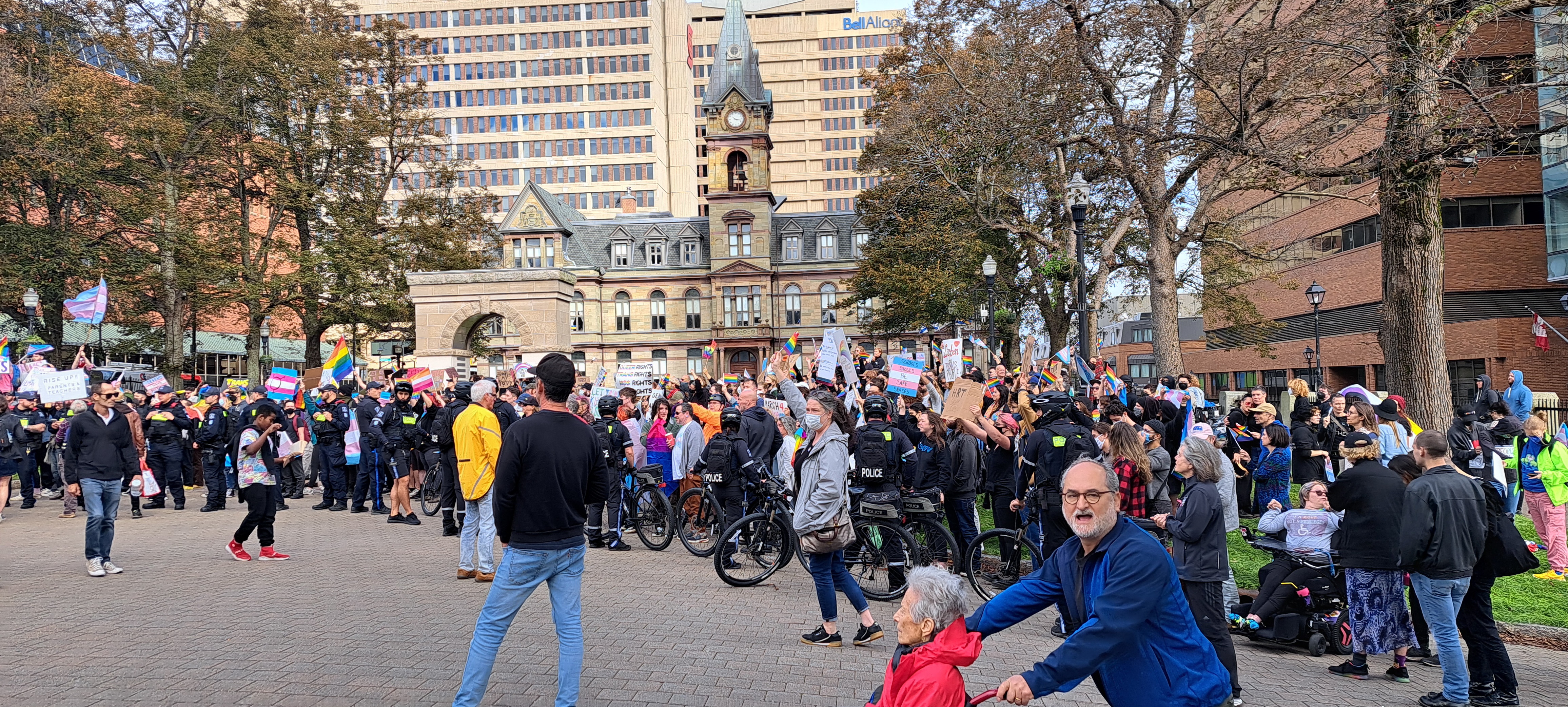
Today I attended a counter protest. I think it was the first for me…I have been to many demonstrations, some of which had counter protesters lurking on the side, but never one like this. I was there as part of “Education Saves Lives” – a response to the deceptively named “March4Kids” which was part of a nationwide manifestation of the also deceptively named Parents’ Rights movement. It was a chilling example of the culture wars that are dividing us – all the worse because they are being fueled by a cynical, anti-democratic lobby that seems to be having its day.

In my last blog post, I posted an article written with Angela Gillis, about the “neoliberal trajectory of public education reform in NS” (Our Schools/Ourselves, Jan 2023). In it we talked about how the lack of school boards in NS leaves our education system open to the influence of small “anti-woke” groups like the above. Indeed we have already seen what can happen in New Brunswick and Saskatchewan where Conservative governments have overruled school boards, educational professionals and even elements of their own caucuses and turned back the clock on the advances their teachers have made with regards to gender identity.

But today’s march both alarmed and heartened me. I was alarmed at the blatantly misleading signs displayed by the parents’ rights group and the fact that there seemed to be a fair number of newcomers to Canada in the crowd. But I was heartened by the fact that the counter-protesters vastly out-numbered the other side, and their signs were much more imaginative. I was also glad to see that there was no violence while I was there.

I longed to be able to have a conversation with some of protesters. Here’s what I would say to them: to the dozens of “Hands off our Kids” sign holders, are you really implying that educators are molesting our children? That teaching about sexuality and gender identity is somehow harming them? To the “Our kids, Our consent” sign holders – no actually, your kids have rights that sometimes trump yours, and one of them is to be safe from abuse, prejudice and bullying. If they don’t tell you about their gender identity or sexual preference, there is good reason, and having a teacher inform on them may put them in danger. 

The irony was not lost on me of another puzzling sign, “Canada has only 1 flag” (usually superimposed on a red maple leaf) when there were literally hundreds of pride flags waving across the parade, not to mention the numerous NS flags in both crowds. But my favourite sign was one that said “School is for learning math and science” – yes, but it also “aims to develop well-rounded, independent, critical thinkers”,1 who need literature, history, sex education, music, art and much more.

.

Most disturbing were the “Stop grooming our kids” and the “Education is Indoctrination” signs –  as if sex education is grooming or sexualizing children. This language is straight out of the far-right playbook in the US where in some states they have already succeeded in passing anti-trans laws, banning books and suppressing many aspects of democratic education in public schools. 

I have a trans grandson, who just turned 14. He is well adjusted and happy and has had mostly good experiences in his schooling. He has had the benefit of understanding teachers, in-depth sex education and a supportive family. I compare his experience to when his mother was going to high school in her small town, where anyone even suspected of being gay or trans was mercilessly bullied. Even more telling is my own experience – in high school, back in the dawn of time, I didn’t really know what homosexuality was. Because I didn’t know about them didn’t mean trans and gay people didn’t exist – it just meant that they spent their youth hiding their true selves, and couldn’t come out til much, much later in life. The progress on this issue over these generations has resulted in many more well-adjusted adults, more acceptance for diversity and yes, fewer suicides.  

I treasure that progress and love the acceptance for diversity I see all around me. Nova Scotia is a much richer place because of it and being part of the counter protest this morning was a heartening experience. But I am still alarmed at the anger and fear we encountered there, not to mention the disinformation and lack of respect for the expertise of educators and their evidence-based research that was on display. I wonder what kind of world my grandson will grow up into – hopefully it will be one which will allow him to continue to blossom and show the world his many gifts. But I am afraid we will have to fight for it, and today was a step on the way.

  1. NS Public School Curriculum document ↩︎

On my way home, I saw this on Spring Garden Road. Related? Or just coincidence…

Not Immune: The neoliberal trajectory of public education reform in Nova Scotia

By Angela Gillis and Molly Hurd

Published Jan.10 2023 in the Canadian Centre for Policy Alternatives Education magazine Our Schools/Our Selves

December 29, 2022 is the 5th anniversary of Dr. Glaze’s report, “Raise the Bar” which dramatically overhauled the governance of Nova Scotia’s education system. The “Education Reform Act” (Bill 72) became law just over two months later in early 2018 and effectively dissolved all the province’s English language school boards. It also removed principals from the Nova Scotia Teachers Union (NSTU). 

Canada has been described as a superpower in public education on the international stage. It has achieved good results on international comparison studies as well as high levels of equity in academic performance. One of the contributors to these results is the generally constructivist attitude towards education – teaching students to think and problem-solve rather than merely absorb knowledge.   

Education is a provincial responsibility and most provinces have public education goals that use language encouraging democracy, fairness, equity, and citizenship. (Nova Scotia’s public education system “aims to develop well-rounded, independent, critical thinkers who take initiative and responsibility for their learning.”)  In the early days of public education in Canada, “success” meant mastery of the 3 R’s, but as society has become more diverse and complex, the definition of success has expanded to include the 21st Century competencies of critical thinking, creativity, communication and collaboration, among others.

As this evolution in education was happening, forces have been trying to counter it – initially through  the “back to basics” movement which emphasized knowledge and skills that can be easily measured on standardized tests. This corresponds with the increasing marketization of education – the idea that education is a business which can be better handled by the private sector. This dual challenge to progressive education has gained steam recently in the United States, where publicly-funded charter and private schools flourish and “culture wars” are seriously threatening public education.  

These “culture wars” are pitting those who believe in democracy, inclusion, and equity against those who claim that schools are indoctrinating children in socialism, openly questioning the premise of equity and inclusion. Disinformation, conspiracy theories and religious fundamentalism are fueling the self-described “anti-woke” lobby. Proponents use inflammatory language such as “pedophilia” and “grooming” to describe curricula and books which educate children about sexuality and gender issues or make disparaging accusations about “critical race theory” to describe teaching about racial issues and history. In the U.S., so-called anti-woke forces have succeeded in getting anti-trans laws passed, in suppressing the instruction of race, history, and 2SLGBTQAI+ issues, and in banning certain books in schools or libraries. “Parental choice” and “parents’ rights” have become code for the increasing privatization of what was conceived of as a public good.

Here in Canada, recent school board elections in Ontario and BC – among others – have seen scores of “anti-woke” candidates openly expressing anti-2SLGBTQIA+ and racist views, some receiving training  from  the well-funded American right-wing think tank, the Leadership Institute . Fortunately, only a small percentage of these individuals were elected, so their influence through school boards – so far – is minimal. 

However, the disturbing issue is that we are no longer merely emulating anti-democratic trends from the U.S.; there is now an organized, concerted effort to train people to infiltrate boards, lobby, propagandize and, eventually, change legislation Left unconfronted and unchecked, this could ultimately result in a population that will be less prepared for the challenges of our increasingly complex world. 

Given these threats to democratic education, how is Nova Scotia positioned – and what steps are being taken – for it to hold on to its aims of developing “ well-rounded, independent, critical thinkers”? 

Unfortunately, we are not optimistic. Since the elimination of English language school boards in Nova Scotia, communication with the “Regional Centres for Education” (RCEs – their unelected replacement) has become a one-way street with communities having no formal channels to express concerns or advocate on issues important to them. The removal of that  mechanism for democratic engagement and feedback has made  it easier for a government to impose top-down curricula and directives.  Another major repercussion is the loss of voices from the African Nova Scotian and Mi’kmaq communities, as identified by Adam Davies, a former school board member. Under the old system, each board had dedicated seats for a member from each group, voted on by self-identified members of that population. This was incredibly important when considering educational initiatives on Indigenous issues or anti-racist education – all important for teaching the critical thinking so essential for citizenship. 

There are already indications of where Nova Scotia is potentially headed, with regard to undermining many of the progressive gains of the past decades. One only has to look at the Alberta UCP government’s attempt at curriculum rewriting, to correct a “schooling system where many students have been hard-wired with collectivist ideas,” according to then-Premier Jason Kenney. School trustees in Alberta were at the forefront of opposition to the government’s anti-collectivist curriculum revamp; without trustees,  Nova Scotia will be in a much weaker position to counter such attempts. 

Along with removing school boards, denying principals the protection of a union, may eliminate another obstacle to education reforms in line with neoliberal goals. Prior to Bill 72, principals acted as curriculum leaders, whose main role was to support the teachers;  being in the union was an important part of this purpose. The Nova Scotia Teachers’ Union (NSTU) was established in1895 to,  “…exert an influence in gaining better salary and aid teachers in securing better results in their school work.” The protective nature of a union allowed both teachers and principals to contribute to reforming education in the best interests of the students without fear of retribution. When Bill 72 removed administrators from NSTU, and created  the Public School Administrators Association of Nova Scotia (PSAANS), its members were not able to organise their own union or take labour action. They remain affiliated with, but are not members of, the NSTU. The affiliation, reaffirmed by a vote in 2022, allows them to leave administration and return to the classroom and the union.

Without union support, administrators may feel vulnerable when challenging situations arise, such as being directed to impose new programs that may have been developed with minimal teacher consultation. Further, their position has been refocused, moving away from curriculum leadership and towards management.  .  Finally, with many administrators choosing to return to teaching roles or retiring, recruitment is becoming an issue. Experienced teachers are often not interested in leaving the protection of the NSTU or in being managers, so in order to attract candidates RCEs are dropping some of the requirements. This means at least some aspiring administrators will have far less experience and, potentially, education than the teachers they will be leading. Will they be well-positioned to push back against government decisions that may not be pedagogically sound?

Before Bill 72, back in 2017 the then-Liberal government had, through Bill 75, imposed a contract on teachers which removed negotiated benefits. Though the NSTU successfully challenged this in the courts, to date, no reparations have been made. BIll 75 was a galvanising event for teachers, who, with parents, protested and were at least partially responsible for the much reduced majority the Liberals were given in the election shortly after. 

Unfortunately, the combined impact of these two bills has contributed to the demoralisation of educators who  saw their autonomy undermined and their working conditions worsened (documented in Teachers’ Voices: An Independent Survey of Nova Scotia’s Teachers ).  This demoralization was no doubt exacerbated by the province’s sudden and unilateral decision to  legislate school psychologists, speech pathologists, and other specialists out of the NSTU (reinstated  as a result of another court challenge).  In addition, some NSTU work is being done by other employees : counselling, substitute teaching, and hallway monitoring are positions that are now sometimes filled by non-teachers. 

The Liberals were voted out in the 2021 election, perhaps partially because of promises made by the incoming Progressive Conservatives to  revisit educational governance, and reinstate school boards. However, to date, they have shown no sign of doing so. In fact, it appears that the trajectory of introducing more programs that further the marketization of education will continue. 

For teachers to exercise their professionalism, and provide students with the critical thinking and media literacy skills that they need right across the curriculum, they need to be supported and respected. Many Nova Scotian teachers have been looking to the U.S. teachers’ unions which have become more militant recently after years of being marginalized and underpaid. Local grassroots organization, Educators for Social Justice-Nova Scotia (ESJ-NS), is promoting union learning opportunities such as Jane McAlevey’s Organizing for Power to increase engagement and awareness of benefits of unionism. Strong education unions, teacher awareness of union protection and advocacy, an educated electorate and  strong, transparent, functioning elected school boards are essential for democracy to survive.   

With the contradictory- named, anti-democratic “Keeping Students in Class” Act, Ontario is facing a showdown with workers that will be watched with interest by everyone in the country, especially in Nova Scotia where many education workers are currently striking. When our democracy is threatened by the very people we elected it is time for the people and their unions to mobilize!

Angela teaches elementary school and has been a member of the Nova Scotia Teachers Union for 25 years. She has Master of Education degrees in Curriculum and Instruction as well as Teaching English to Speakers of Other Languages. In her spare time, she is trying to regain elements of her culture, virtually lost through generations of English immersion, by studying Cape Breton Step Dance and Gàidhlig.

Molly has had a wide variety of teaching experiences in northern Quebec, rural Nova Scotia, Nigeria, Tanzania and Britain. She was teacher and Headteacher at Halifax Independent School for 20 years and is the author of  “Best School in the World: How students, teachers and parents have created a model that can transform Canada’s public schools”.

Angela and Molly are both longstanding members of Educators for Social Justice – NS.

References

Nova Scotia Teachers’ Union (2001). Landmarks and Challenges: A short history of the NSTU. Halifax. https://nstu.blob.core.windows.net/nstuwebsite/images/Documents/Full_History.pdf

Canadian Association of Principals and the Alberta Teachers Association (2014). The Future of the Principalship in Canada: A national research study. Alberta. https://legacy.teachers.ab.ca/SiteCollectionDocuments/ATA/Publications/Research/The%20Future%20of%20the%20Principalship%20in%20Canada.pdf 

Educators for Social Justice. 2019. Teachers’ Voices: An Independent Survey of Nova Scotia’s Teachers. Halifax.  

The Latest Reading Wars

Commentary in the Chronicle Herald, Saturday December 17 2022

Following a recent spate of letters and op-eds (Andrew Rankin, Nov. 22 et al) regarding the “failure” of Nova Scotia schools to teach all our children to read, I would like to add another perspective to what are now called the “Reading Wars” in education circles.  These new reading wars pit proponents of the “Science of Reading” (whole class systematic phonics instruction in early elementary) against the current “Balanced Approach” to literacy.

As an elementary teacher and researcher of over 30 years, I have taught many children to read, using many different methodologies, and a couple of things have stood out to me. One is that all children learn and develop differently and at different rates. Some children learn to read seemingly effortlessly before they even reach school, others learn in Grade 1 (where the curriculum dictates all should learn) and some need more targeted attention and learn to read in grade 2 and later. A small percentage of children don’t respond well to whole class instruction and will struggle with reading in early elementary, and some of these will fall through the cracks and be labeled dyslexic. 

The second thing that stands out is that after researching for years, I have never found an academic study that has definitively proved that early reading leads to better academic outcomes in high school and beyond. In fact, my observation is that there is no correlation at all – some early readers become bored with school and give up on it; other children who learn to read at 7 or 8 become academic superstars.

I have, however, read lots of research about the value of play in the early years, including in elementary school. Dramatic play, unstructured play and sensory play all have been shown to improve children’s creativity, communication skills, literacy, physical health, and cognitive and socio-emotional development – all important foundations for reading. In fact, prominent educational thinker Pasi Sahlberg and his co-author Bill Doyle, have written a book entitled “Let the Children Play: Why more play will save our schools and help children thrive”.

The “failure” of schools to teach all our children to read is not the fault of a particular methodology, but is instead a failure of our schools to provide the type of solid early basis for literacy (I would recommend 2 or 3 years of literacy-rich play-based learning} as well as a failure to provide the type of individualized reading help in later elementary to those children who need it (not just in Grade 1). At ages 6 and 7, when most children are developmentally ready to tackle the code that is written English, give them interesting books to read and exciting activities to write about as well as the phonetic knowledge to do those things. Most children will begin reading fluently and joyously in those years. For those that don’t, many just need more time, and a smaller subset will need small group or individual focus on phonemic awareness.

The Science of Reading lobby proposes whole class systematic phonics teaching in Primary and early elementary to make sure that those children who may be later diagnosed with dyslexia get the “early interventions” they will need. The problem with this approach is that the vast majority who are NOT dyslexic (95-98% of children), who are taught phonics intensely in Primary, may become bored with or worse, anxious, about reading, as well as being deprived of an opportunity for literacy-rich play. The UK, where systematic phonics has been taught at ever earlier ages for several decades now, has not substantially improved reading scores on national and international tests, and studies are showing a drop in numbers of children reading for pleasure.

Rather than thrusting a whole different approach to teaching reading on already overburdened teachers, let’s first deal with the underlying failures mentioned above. One way that could help would be to reorganize early elementary into multi-age groups, thus lessening the pressure on teachers (and children) to achieve grade level outcomes. Reading Recovery programs have not been completely successful because they are aimed at 6-year-olds, under the assumption that all children are ready to learn by then. If children are not ready, the program is wasted on them, even though a year later they may be ready to take in what it has to offer.

What if we thought of early elementary as a 5 or 6-year block?  Children would spend 2-3 years in the “pre-literacy” class – a mixed group of no more than 20 4 and 5-year-olds. Ideally, they would spend that 2-3 years with the same teacher and group of children, and the program would consist of enriched play-based literacy activities. When they are deemed ready, they would move on to the next stage, “Focus on Literacy”, where literacy is introduced formally (keeping in mind that a certain percentage of children will have already learned to read, either on their own, at school or at home). Again these classes should be no more than 20 children, and ideally they should stay with the same teacher for 2-3 years. The flexibility allowed here would eliminate many of the problems associated with “social promotion” and would address the cultural/socio-economic gap in later educational outcomes caused by lack of exposure to standard English or traumatic early experiences. As well many children start school at the age of 3 ½ and may benefit from an extra year of play just because they are so young. Teachers get to know the children well, and with smaller classes can make sure that each child gets what they need when they need it. 

When children are reading independently and are mature enough, they can move on to upper elementary, where they continue to build on their literacy skills and deepen their understanding of the English language and a whole world of knowledge that will unfold for them.

I am happy to learn from the developments in neurological research that are informing the “Science of Reading” and feel that used in a targeted way, it can be very helpful. But I know that phonics is only one skill in the vast array of skills necessary for good readers. Most children will learn to read when they are given the time and teaching that is developmentally appropriate, individualized and allows them to experience the joy of good literature. It seems self-evident that children who read a lot and read well will do better academically – but they have to want to read. Forcing them when they are not ready is a sure-fire way of discouraging them.

Two letters to the Editor

A few weeks ago, just after in-person learning resumed in Nova Scotia schools, this column appeared in the Halifax Chronicle Herald. It was written by Paul Bennett, and demonstrated such a complete lack of knowledge and empathy for what actually goes on in public schools that two members of Educators for Social Justice – NS independently wrote letters refuting it – Ben Sichel and I. They were both published on the same day (February 9, 2022) and I am reproducing them here for those that do not subscribe to the CH. Immediately below is the link to the original column:

https://www.saltwire.com/nova-scotia/opinion/paul-bennett-covid-hype-breeds-hypervigilance-on-school-cases-in-nova-scotia-100684723/

My letter: Teachers, Parents not irrational

Paul Bennett’s op-ed “COVID hype breeds school hypervigilance” Saturday January 29 2022. characterizes a large proportion of teachers and about 57% of parents of young children as being “excessively anxious” and suffering from “cave syndrome” with “psychological fears, real and imagined”. Really? Are the majority of Nova Scotia parents and teachers actually irrational? After 2 years of a pandemic, and 6 weeks of omicron, many classrooms still do not have adequate ventilation, social distancing is a joke, the 3-ply masks promised turn out to be inadequate, contact tracing which parents relied on has been discontinued, classes are still too big – and all this in spite of a mostly unspent $40 million in federal government funds designated to make schools safe for in-person learning. Bennett doesn’t mention the fact that only about half of the children under 12 had received one dose of vaccine by Jan. 17 when in-person learning resumed, and none had received two. No 4 year-olds were vaccinated at all, and many teachers had not received their booster shots. All of these are real safety fears, and to treat them as imagined is belittling and arrogant.

Teachers taught successfully online for the week of Jan. 10-15. The issue is how long that should have continued. Just about everyone, teachers, parents, students and pediatricians, agrees that in-person learning is best for students – not just for mental health, but for actual learning. So when teachers and parents of the not-yet fully vaccinated under 12 children express reservations about going back to in-person learning so soon, especially when the 3 other Atlantic provinces decided to do one or two extra weeks of online learning to get past the peak of omicron, one would have hoped that the government might listen. Teachers warned about high rates of sickness and absences among staff that would impact the quality of the in-person learning, and the strain on those left to carry the burden. Parents worried about their children bringing omicron home to vulnerable family members. These worries were not irrational – all of these things have happened, and we are not finished with omicron yet.

Bennett claims that the parent Facebook group Nova Scotia Parents for Public Education, built its membership by “creating an early-warning system for school-level exposures”. This group has existed since the teachers’ labour dispute with the government 4 years ago when it was created to support the teachers. At its peak it had almost 40,000 members. Its case reporting tool relies on anonymous reporting by parents whose children tested positive, with the name of the school involved. To date it has recorded 780 cases (most likely there are many more) and has served its purpose of filling the gap left by the government, giving parents information that lets them make informed decisions about their children attending school. 

Educators and many parents had rational reasons for suggesting delaying the return to in-person schooling by one or two weeks. Their legitimate safety fears were ignored, and even the modest request by teachers that they be prioritized for booster shots, as other frontline workers were, was denied. No wonder they feel disrespected and demoralized, a situation left over from the previous government’s lockouts and forced contract. And for what? 2 weeks of what has been a chaotic, dangerous return to in-person school. 

Ben Sichel’s letter: Armchair Edu-critic insulated from COVID

Yesterday I spoke to an elementary school teacher who contracted COVID-19 from her class. The infection happened months ago, but the teacher is still off work due to long-term health complications. 

Earlier that morning I had read Paul Bennett’s latest column, in which he calls concerns about COVID in schools a “moral panic.” 

The so-called polarized debate about keeping schools open during Omicron is, like many such debates, over-simplified. On one side, the story goes, are those concerned about the virus spreading in schools; on the other are those who insist we need to “learn to live” with it. 

Reality is of course more nuanced. Nearly everyone wants schools to open. Many of us who spend our days in them, however, have been sorely disappointed by the lack of imagination (and more importantly, investment) in keeping students and staff truly safe — physically, mentally and emotionally. 

Even those who voice concern about schools opening would likely feel better if governments implemented any of the many reasonable precautions suggested throughout the past two years to make schools as safe as possible. During the current wave staff and students have not been provided with N95 masks; school staff were not prioritized for boosters; school reopenings were not delayed to allow children to get second doses of vaccines. Structural changes such as sending older students to school every second day in order to reduce contacts were never considered. There has never been any plan for equity for immunocompromised students and staff, for whom it is simply too dangerous to attend school in person. 

The province has still not legislated adequate paid sick days, which would allow parents to stay home with sick children rather than send them to school. Overcrowded classes, which made for poor learning conditions before the pandemic, make social distancing impossible.

Of course, none of these issues has ever registered for commentators like Mr. Bennett, who hasn’t worked in a classroom in decades and writes from the comfort of his home office. “Learning to live with COVID” means something different when you’re the one being told to put yourself at potential long-term risk. 

Our society has the means for us to take care of each other. We should make sure we do whatever we can to keep kids, school staff and other essential workers safe — and that’s a long way from what we’re doing. 

Why not listen to teachers and delay in-person school a couple of weeks, Mr. Houston. Live up to the “progressive” in your party’s name!

My last blog post was written on the eve of the August provincial election where I was extolling the virtues of minority governments and the progressive change that collaboration can bring about. When the “Progressive” Conservatives squeaked out a tiny majority in NS, mostly on the basis of their platform of “fixing” healthcare, initially things looked a bit promising. The new government seemed to be continuing the previous government’s cautious approach to COVID, and there were even some positive initiatives (Owl’s Head, new training initiatives for nurses and long-term care workers). I even heard people suggesting that these Conservatives were more progressive than the Liberals!

Then we learned that Premier Tim Houston believes that there is no housing crisis – just increasing the housing supply will increase housing affordability (eventually perhaps – it hasn’t worked very well over the past 20 years). Now comes the Omicron variant. When cases exploded before Christmas, the government took the sensible step and closed school a few days before the holidays when they realized it was spreading in schools (all the while declaring that “COVID doesn’t spread in schools”). At the end of December, daily case counts were in the thousands and overloading the province’s testing capacity, so PCR tests were severely restricted (thus rendering daily case counts vastly underreported) and the government decided to delay the return to school for students for a week. By the end of that week, cases were through the roof, hospitalizations were starting to rise, and the government wisely declared the next week an “on-line learning week”. 

Nova Scotia had the opportunity to learn from the mistakes of other provinces who went back to in-person learning on January 10 – just reading the headlines should have been enough warning. Both Saskatchewan and Alberta experienced high rates of teacher absences, and had to scramble to cover classes – what is the educational (and safety) value of in-person learning when it means combining classes or having unqualified people teaching? On Thursday Jan. 13, all the other Atlantic provinces announced delaying their return to in-person classes until at least Jan 24 or 31  to safeguard  the teachers and students. 

Unfortunately, Nova Scotia did not follow suit. In the middle of the biggest outbreak of COVID we’ve seen so far in this 3rd year of the pandemic the government decided to open schools for in-person learning on Jan. 17. Although teachers (and their union) agree that in-person learning is important for mental health (and many other reasons) many teachers and students  have not been able to be fully vaccinated yet.  An extra week or two of online learning would allow more to be fully vaccinated, and perhaps flatten the curve of hospitalizations and deaths.  The messaging from the government has  claimed upgraded ventilation, 3 ply masks for all students, and cohorting  were in place, which often turned out not to be true. However, the coup de grace was the government’s decision to stop contact tracing in schools, while telling educators they are not at liberty to tell parents when there has been a confirmed case in their class. Parents are not to be told if a child has been exposed at school and thus have no way of protecting the rest of their families.

So, school went back on Monday this week. Many parents were very conflicted about sending their children back (about 56% according to an unofficial poll taken by the Facebook group Nova Scotia Parents for Public Education). Teachers were and are scared – some that I talked to had tears in their eyes as they described the probable outcome – colleagues “going down”, children getting very sick, vulnerable family members dying. Unspoken was the fear that a child could die as a result (and this week’s news reported an otherwise healthy child in Calgary dying of COVID).  Some teachers cited safety conditions (lack of ventilation or crowded classrooms) in refusing to work – and were reassigned to other duties or other schools. A few teachers are protesting the lack of contact tracing in front of their MLA’s office after school. 

Meanwhile, the Nova Scotia Parents for Public Education has reactivated their “cases in schools” reporting tool, which by this morning reported 192 cases, mostly in HRM, a number that is vastly underrepresenting the true number of cases as it relies on self-reporting of members of the group. Official reported daily cases are hovering around the 500-700 mark in the province (because of the lack of PCR testing, the real number could be as much as 5 times higher), hospitalizations are rising and there have been 3 deaths a day for the past couple of days. It’s still too early to tell where this will lead, but I am fearful we will see another spike.

But one thing is clear – there has been nothing this new government has done to send a message to teachers that they will be respected or listened to anymore than the last government. Remember the Glaze Report, Bill 75 and the lockout of teachers? See  https://progressiveeducationnovascotia.com/2018/02/  The “Progressive” Conservatives had the opportunity to prioritize teachers for booster shots back at the beginning of the Omicron surge and they didn’t. They could have shortened the waiting time between doses for kids aged 5-11 (as other provinces did) so they could get their two doses by the start of in-person learning, and they didn’t. They’ve had 6 months to use some of the $40 million in federal funds to make schools safer – installing ventilation in schools that don’t have it, upgrading ventilation in schools that have old systems, giving proper PPE to staff, making smaller classes – and they didn’t. Instead, there were confusing press conferences in which teacher and parent groups were accused of fostering fear and anxiety and spreading misinformation. We were told that there needs to be in-person learning right now because as Houston said, “the brutal reality is that for some kids, school is the place where they are safest…it’s sad but true. It’s the place where they are most warm…and they get food” – implying that child poverty (1 in 4 children in NS) is something that in addition to everything else, it’s teachers’ job to fix (but not his job to do something about in the provincial budget). When they object to unsafe learning conditions, teachers are derelict in their duty to these children.

The bottom line is: educators had legitimate requests and concerns about going back to in-person learning in the middle of the fifth wave, and they were disregarded. This doesn’t bode well for the future. Although I’m hoping that Houston and his colleagues can learn from this, and in future, no matter what the issue is, listen to the people most intimately involved in it (usually the workers) while making their difficult decisions, so far they are not living up to their “Progressive” name. Respect educators (and all other frontline workers), Mr. Houston!

Collaboration is the future: Minority governments

August 16 2021

As I sit here on the eve of one unwanted summertime election, and anticipating the beginnings of another, I am reflecting on some of the rhetoric I keep hearing about the necessity of voting for one or other of the two major parties. The story goes that we have to vote Conservative because they are only ones who have a hope of forming government and stopping the Liberals (and vice versa). And in particular, as I watch the federal Liberals call a totally unnecessary election solely in order to go for a majority so “they can get things done”, I wonder what happened to the “partnership” they had with the NDP and the “deals” they made early in the pandemic  to pass CERB and other pandemic benefits. https://www.ctvnews.ca/politics/liberals-secure-covid-19-aid-deal-with-ndp-avoiding-election-1.5120095 . This includes paid sick leave, pushed for by the NDP, which otherwise would not have been part of that bill. The Liberals can’t work with the NDP because they don’t want to, it’s as simple as that. And they think they can ride the coat-tails of the pandemic to a majority.

In NS, our Liberal party has made the same calculation – they are hoping that by listening to public health advice about the pandemic and keeping our COVID numbers down, we will forget about everything that has happened in the previous 7 years of their rule. But it may not work – polls tell us that we may be going into minority territory, and that possibility makes me happy. Just this morning, in an excellent column in our local newspaper, Leo J. Deveau writes about this week in 1927 when “In this year, after considerable pressure from J.S. Woodsworth, Leader of the Labour Party (1921-1932) – and later the Cooperative Commonwealth Federation (1932 – 1942), PM Mackenzie King was persuaded to introduce an old age pension plan in exchange for Woodsworth party support of King’s minority government. It was Canada’s  first social welfare legislation – the Old Age Pension Act.” https://www.saltwire.com/halifax/lifestyles/leo-j-deveau-this-week-in-nova-scotia-history-aug-16-to-22-100622568/ . The CCF was the precursor  to the NDP, which later under Tommy Douglas and various minority governments brought us medicare and other social programs. Without minority governments, I might not be anticipating collecting my old age pension in a year or two and we certainly wouldn’t be debating about the best way to fix our public healthcare because we wouldn’t have one. **

Although I’d love to see the NDP form a government, a balance of power (or opposition) situation could also be an excellent thing as the party under Gary Burrill exerts pressure to achieve many of its progressive goals (including tackling climate change, healthcare, affordable housing etc). In previous posts on this blog, I have documented the disasters wreaked on the education system under the ever so slim majority government of the Liberals. Throughout it all, Gary and education critic, Claudia Chender have supported teachers, parents and children. The NDP platform vows to “Work(ing) in partnership with teachers and parents to improve schools, instead of continuously picking fights with stakeholders, as the Liberals have done.” That would be a huge improvement on what we have been living with for the past 8 years. Collaboration is the future.

**Did you know that Nova Scotia’s pension plan was paid for initially by the profits from liquor sales after the ending of prohibition? Neither did I.

November 4 2020

The Day After 

On November 2 2016, I woke up in a London hotel room on a dreary day to the TV blaring “President Trump” at the world. I had gone to bed the previous night, before many polls in the States had closed, secure in the knowledge that the world under Hillary would bump along in its usual fashion – a few victories for social and environmental justice, a few setbacks, but overall moving along towards a better world. And then Trump.

The depression that hit me over the next few days, as I plodded around rainy London, was not helped by listening to academics studying economic inequality. Their research was telling them that one consequence of the runaway inequality many countries were experiencing could be fascism. The “most powerful man in the world” was a fascist – how good was that?  But almost immediately, we started to tell ourselves that it might not be so bad – there is a strong American commitment to democracy with so many checks and balances within the system, and Trump might even rise to fill the role with some dignity and learn to govern. But then, with increasing rapidity, Trump began to overturn all those hopes, and worse. The past 4 years have been a nightmare of watching a narcissistic conman bamboozle his supporters and trash everyone else.

At that time, I blamed the American education system for Trump. Decades of whittling away at the public school system under Republicans and Democrats alike, undermining teachers, focusing on exams and “standards” unconnected to real learning, and encouraging school choice (vouchers, Charter Schools) have created an unequal system where most learning is about how to best raise exam marks. The poorest schools have the furthest to go, so they have the least time and capacity to teach critical thinking, a nuanced view of history or real scientific literacy. And forget about the 21st century skills that have been acknowledged as essential for living in this world – “collaboration, critical thinking, communication, and creativity” (National Education Association). So many Trump voters were incapable of separating truth from fiction, and were taken in. Once they accepted the “fake news” narrative, all else followed. COVID is fake news, experts are fake news etc.

But then, 4 years ago, I was persuaded that many voted for Trump for good reasons – they distrusted Hillary (because she is a woman?), their manufacturing jobs were gone, inequality had left them behind etc. So I waited, thinking that these people would soon have the scales ripped from their eyes – but then last night happened.

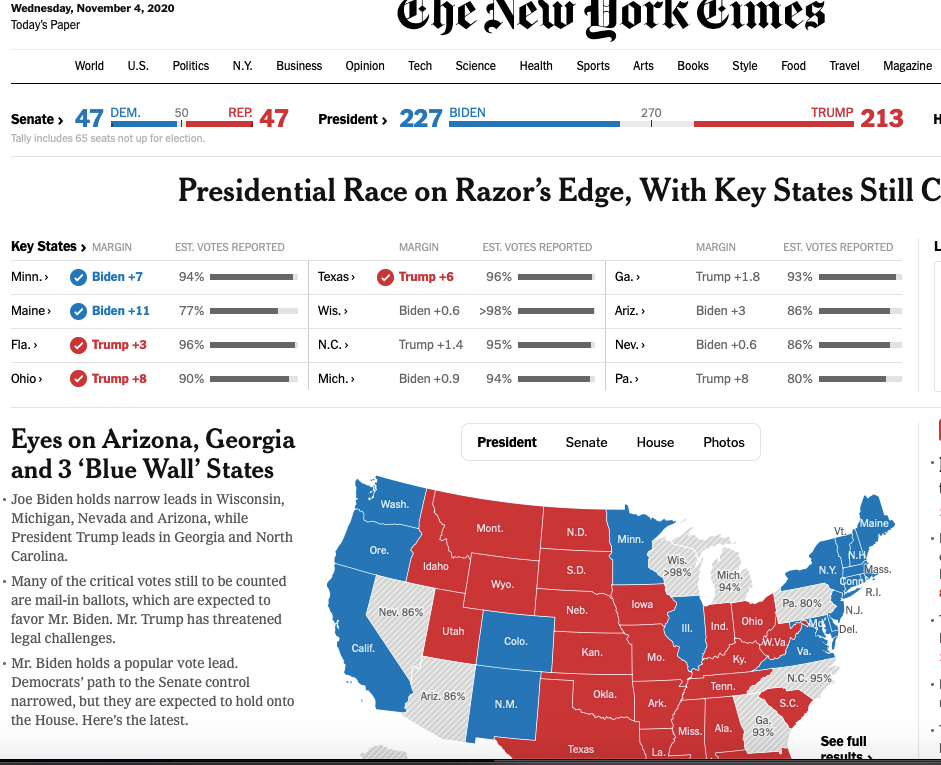
And now it’s the day after, 2020. I know it’s not over yet; there’s still hope. But why wasn’t it a landslide for Biden? Why did so many Latinx voters support Trump in Florida? Why did people believe him over Dr. Fauci? How did he manage to equate socialism with the devil? How did outlandish conspiracies, formerly the stuff of the National Enquirer, get to be swallowed by so many?

So I come back to the American education system, which trails most other OECD countries on international education comparisons, including PISA. One of the interesting findings of PISA, which I expand on elsewhere in this blog, is that the best education systems in the world value both excellence and equity – in other words,  it is not enough to have excellent schools (the US has some of the best public and progressive schools in the world), that excellence needs to be shared.  And that is where the US falls down – their public education system has been under attack for decades, and the inequality within it has widened under Trump and Betsy DeVos, Secretary of Education. The charter schools, which she promotes, have contributed to this, and have further undermined the public system (while lining the pockets of many). 

Last night, looking at the vote breakdown on the maps of the swing states, it was a perfect illustration of Trump’s strength with rural voters (where schools, I’m guessing, may be a tad less resourced than urban ones). Pennsylvania, where all eyes are fixed today, has vast areas that are all red, and only a few small blue dots – which happen to be the urban areas with the largest population density.

That the divide in the States is not just rural/urban, red/blue etc but reflects the inequality in the education system became clearer to me over the past few days. I watched and listened as the Canadian media, in its quest for balance, interviewed numerous Trump supporters, many of whom are quite articulate. I’m not talking about the career Republicans or the evangelical/corporate types who support him because he is doing their bidding. I’m talking about the regular Josephines…the 18 year old first time voter or the granny who thinks the economy is doing great with Trump. When I hear them repeat some of Trump’s lies and insults – like Biden is a socialist, Obamacare is bad, COVID is overrated, etc and then go on to build their world view based on this, I realize that they are not applying what should be one of the basic 21st C skills – critical thinking, and  in particular, weighing the relative believability of your sources. We can thank under-resourced inner city and rural public schools who have had to focus on raising test scores to the detriment of teaching 21st C skills for this.

And if Trump wins, he has promised to protect “America’s Founding Ideals by promoting patriotic education” – whatever that means. Heaven help them. And us.

Back to school in a pandemic – Safety means smaller classes

September 9 2020

How many times have we been reminded that we should be working towards a “just recovery” from this pandemic?  We can take advantage of the crisis to get rid of the inequities that plague us as a society – fix homelessness, provide a decent living for all, and improve the situation of our elderly. We know that inequities in the way children have survived the closing of schools will become more obvious as the school year progresses, and need to be fixed – why not for good? 

Parents, teachers and children experienced more than the usual first day of school jitters this year. For some teachers, the jitters approached panic as they contemplated the unpacked boxes, the new routines to be learned, the furniture to be disposed of, the faulty ventilation needing to be fixed – all the extra tasks that teaching in a pandemic create. On top of that many have fears about the safety of the students and staff as a result of government plans that seem hastily put together and contradictory to scientific evidence. 

In Nova Scotia, that sense of doom is compounded by a premier whose “angry dad” persona telling them it’s time for teachers to “step up” (as if they haven’t been preparing, planning and shopping for weeks) and who has denigrated their union, ignored a petition signed by 11,000 parents and supporters and dismissed their concerns. The abolition of school boards 2 years ago, and the removal of principals from the Nova Scotia Teachers Union (NSTU) has deepened the sense that there is nowhere to turn, no one to answer very legitimate questions and no recourse if things go wrong. 

What is behind all this angst? After all, we do have very low rates of COVID at present, and almost zero community transmission, so surely it’s okay to restart school with some basic health protocols? And everyone recognizes the need for children to be back in school – both for their development and health and to allow parents to get back to work.

I see two major reasons behind the fear of many parents and teachers. The first is that we have been told repeatedly that a second wave is coming, and that it may well be worse than the first if precautions are not taken. We’ve had the idea of 2 metre physical distancing drilled into us, and our government has used this as an excuse to shut down the legislature and all its committees for the past 6 months. Why then is it suddenly okay to have schools open up in seeming disregard for this basic precaution, especially in view of the “inevitable” second wave? 

The second reason is the fear that some of changes being implemented will set back education instead of being part of a “just recovery”.  For years, waves of austerity and neoliberal policies have underfunded education, undermined staff unions and pushed a privatization agenda that has threatened what is one of the best public education systems in the world. Smaller classes, enriched arts and science education and progressive teaching methodologies have been proven to promote excellence in education as well as equity – socio-economic background has less effect on academic achievement here than in many countries. Many provinces have disregarded this research. 

Given these factors, teachers and parents all across the country have been calling for smaller classes, backed up by the report from the Sick Kids hospital in Toronto. “Smaller class sizes should be a priority strategy as it will aid in physical distancing and reduce potential spread from any index case” p. 10  http://www.sickkids.ca/PDFs/About-SickKids/81407-COVID19-Recommendations-for-School-Reopening-SickKids.pdf . The ideal for Canada would be 15-20 children in a room – this would allow for better physical distancing, but more importantly creating these small cohorts or bubbles would make contact tracing and quarantining those contacts much more manageable in the event of an outbreak. Denmark opened schools last spring with success – with bubbles of no more than 12 children.  It would also allow the youngest children to play and learn freely without masks. There have been many creative suggestions about how this could be achieved with minimal expenditure (many hoped that the new federal money would have been spent on this) – hiring extra staff, utilizing community spaces and extra rooms in schools, and putting older, more independent students on shifts so that their classrooms could be used for younger cohorts. 

With few exceptions across the country none of these suggestions have been implemented; the one province that seems to have listened to this advice is New Brunswick, where P-Gr. 2 classes are capped at 15, Gr. 3-5 classes are “reduced where possible” and high school students go on shifts, but have classes reduced to respect physical distancing. 

Many teachers and parents are asking – how come New Brunswick can do this, and we can’t? It is certainly no richer that we are, but perhaps they are taking the longer view – implementing changes that may result in positive benefits to education after this is all over. Or perhaps it is just based on the best available research at this point in time. 

Whatever the reason, New Brunswick is pretty much alone across the country. No other province is actively reducing class sizes – two provinces however are overtly encouraging parents to keep their children at home with government directed online learning plans…originally it looked as if that was the way they would reduce in-person class sizes. However, it now appears that Ontario is forcing parents to pre-register their children for in-person classes, and then collapsing classes so that many elementary and middle school classes are even bigger. Alberta is also encouraging online learning, and at the same time loosening up the restrictions for charter schools, under the guise of promoting school choice (for a look at the failure and drastic consequences of this movement, check out https://networkforpubliceducation.org).  Both these provinces have premiers who are definitely from the non-progressive Conservative (or Reform) end of the political spectrum, and the fear is real that the pandemic is playing into their plans to further undermine public education. At this point, between 30 and 40% of children in those provinces are being kept home this year.

Quebec, at the opposite extreme, is making in-person attendance at school mandatory. If the rationale for this seems mystifying, one just has to look at France, which also has instituted mandatory attendance. When France passed no hijab/face covering rules, Quebec followed – one wonders how that is going now. And again, it will be interesting to see how mandatory attendance is enforced, particularly given that both places have relatively high levels of COVID right now. 

Both Quebec and Alberta, who started school earlier than other provinces, already have cases of COVID in schools – in Alberta, cases in 11 schools have resulted in hundreds of students having to quarantine for 2 weeks. https://www.theglobeandmail.com/canada/alberta/article-alberta-orders-hundreds-of-students-to-stay-home-after-potential/

A look at the various provinces’ masking policies is also instructive. All provinces have rules in place that require at least the older children to wear masks on buses and in common areas of the school. Only Ontario and Nova Scotia have instituted a policy which says that all students from grades 4 – 12 must wear masks in the classroom as well. Here, it seemed like as soon as the government realized that masking in class was an option, great, they could abandon all pretence of physical distancing. They are not taking into account how this will affect learning, how it will be enforced, and what happens when students defy the rules. In middle and high schools where large classes of over 30 are common, this is a real concern, particularly given the new research that says that children over the age of 10 are just as likely to get and transmit the virus as adults.

School has started, but it’s not too late for governments to listen to the experts (teachers, medical professionals, parents) and make plans to transition to smaller classes now before a second wave hits us and forces us to shut down schools entirely. In Nova Scotia we are already suffering from the teacher shortage we have been predicting for years now https://progressiveeducationnovascotia.com/2018/04/18/standardized-tests-can-lead-to-a-2-tier-education-system-part-3/, and this has been given as one barrier to smaller classes. A show of trust in teachers, along with the chance to teach the way they know is best in smaller groups might go a long way to tempting some disaffected teachers back into the profession. The money it would cost is the best investment in our future – keeping us safe while maintaining a strong, progressive public education system that would address the inequities that have been exacerbated by this pandemic. After all, who wants to return to normal? We can do better!